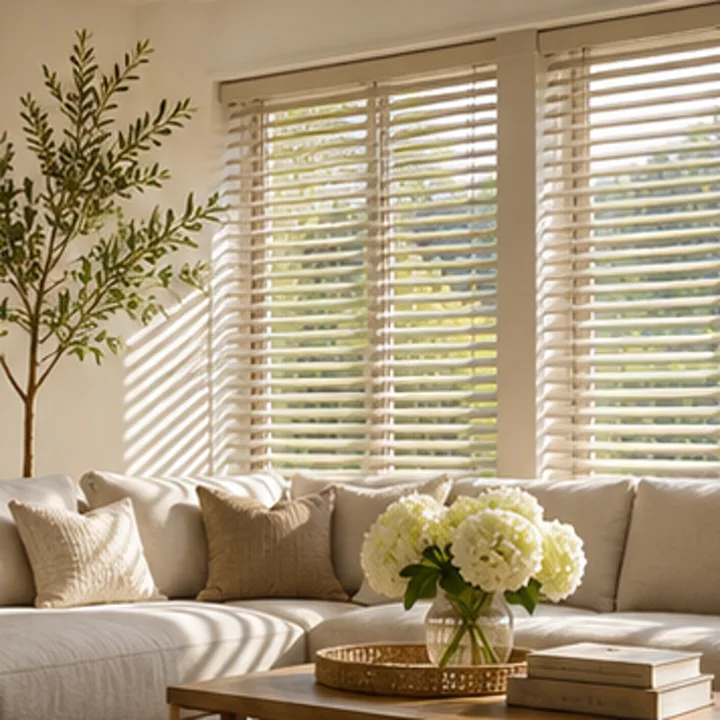
ComparisonRoller Shades vs. Slatted Blinds
Compare roller shades, faux wood blinds, and aluminum blinds for glare, privacy, cleaning, and the view from your room.
By Khristmas Putman
The bottom line
Choose a roller shade when you want a smooth face that can disappear above the glass. Choose slatted blinds when you frequently redirect light or want daylight without exposing the entire opening. In a room where you work at a screen, pay particular attention to when direct light reaches the desk. Tilting slats and lowering a solid fabric solve glare in different ways.
What to look for
- Look at the window from your usual chair or standing position.
- Decide whether you would adjust slat angle or shade height more often.
- Check the slat or roll depth against your available frame depth.
- Choose cordless lift in spaces where young children live or visit.
At a glance
Approximate U.S. price ranges vary by size, seller, and date.
| Option | Price range | Material | Size | Best use | Pros | Cons |
|---|
| Roller shade | Lower to midrange | Roller fabric | Stock or custom window width | Simple lines and adjustable coverage | One smooth surface | Coverage changes with shade height |
|---|
| Faux wood blind | Midrange | Faux wood slats | Measure slat clearance and frame | Privacy and controlled daylight | Tilt helps direct light | Slat stack and more dusting |
|---|
| Aluminum blind | Lower to midrange | Metal slats | Measure width, height, and depth | Compact windows and daily tilt | Multiple slat positions | Thin slats can bend |
|---|
What to know
How each design handles glare
A roller shade controls exposure by covering more or less of the glass. A fabric with more coverage is useful when harsh sun reaches a desk or TV. Slatted blinds add another variable. You can angle them to change the direction of incoming light while the covering stays lowered. Take a note of the sun’s angle when the room is hardest to use.
How daily maintenance differs
Roller material gives you a broad surface to dust, but deep scrubbing or soaking may damage some coatings. Blinds divide the job across multiple horizontal surfaces. Narrow metal slats and wider faux wood slats require different handling pressure. If grease or condensation is common, read the model’s cleaning and material instructions before deciding.
What you can see when closed
The lift, slat fittings, and outer edges all affect outside views and visible light. Ask how large the perimeter gap is for your frame and whether the slats lie flat enough for your privacy needs. Fabrics vary in opacity. To check after-dark privacy, look from outside while a lamp is on inside.
Who it suits
Good for
Use this comparison for everyday rooms where sunlight changes and you expect to adjust the covering regularly.
Consider an alternative if
If you need stronger bedroom darkness, compare an outside-mounted blackout fabric or lined curtains with the options here before committing to a slat design.
Frequently asked questions
Will tilted blinds stop all glare?
A good tilt can redirect rays, but the angle and window orientation determine how much direct light still reaches your chair.
Can a roller shade leave the upper glass uncovered?
A standard top-mounted roller covers the upper area first as it lowers. Check specialized designs if you want the opposite coverage.
Which is easier to dust?
A smooth roller has fewer surfaces. Follow the maker’s guidance for cleaning the exact fabric, finish, or slat material.
 Master Woven Silk